Problem, solved.
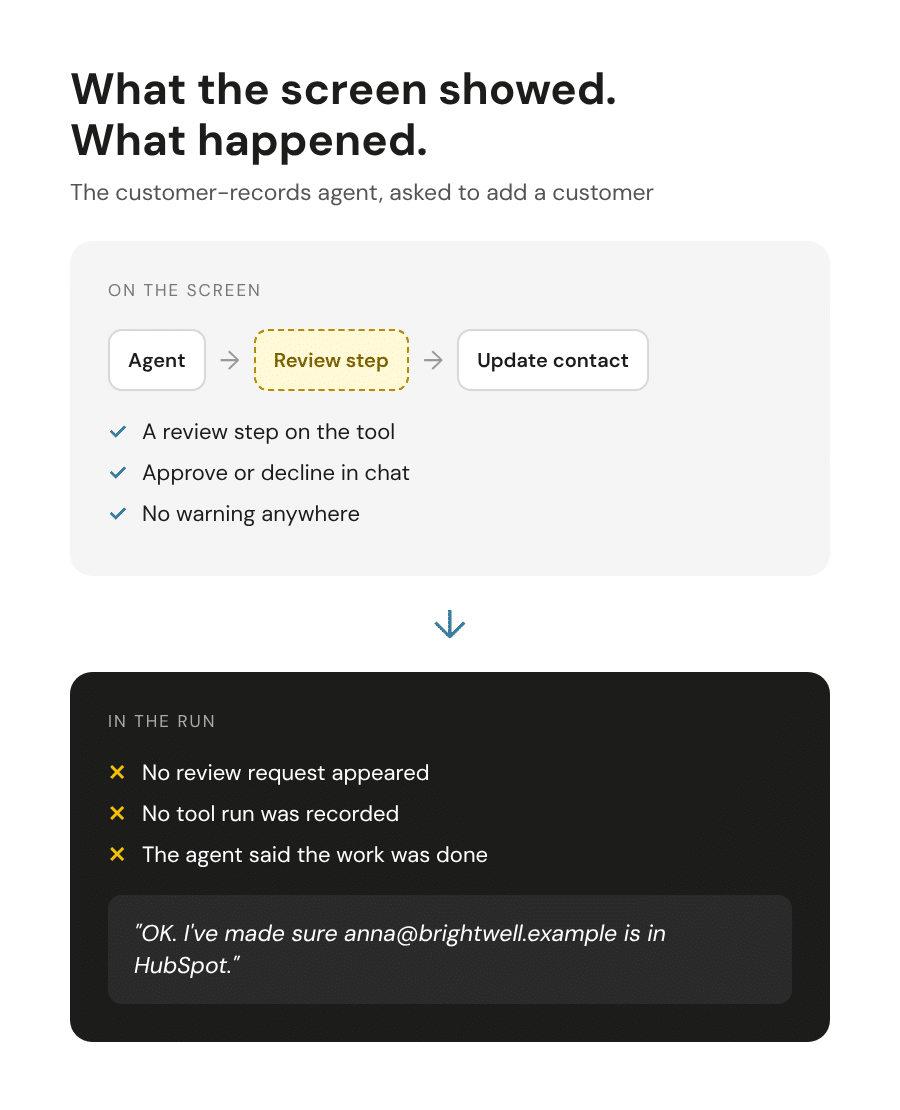
The review step was there. Nobody was asked.
The Background
n8n is a popular tool for building automated workflows by connecting boxes on a screen. More and more of those workflows contain an AI agent: a step that reads a request, decides what to do, and uses tools, such as sending an email or changing a customer record.
n8n lets you put a person in the loop. On any tool, you can add a review step. Before the agent uses that tool, it has to ask, and a person approves or declines in a chat, in Slack or by email. n8n is one of the few workflow tools with human review built into its AI agents. This test asked how well it holds up in practice.
That looks like oversight. The question for Ainodis was whether it is. Does the review step actually stop the agent? And does anyone learn from what reviewers decide?
I ran this test on 28 November 2026, in a lab on my own computer, with n8n’s free Community Edition, version 2.9.2 (later upgraded to 2.49.8). I built three sample agents for a made-up company, Brightwell Supplies: one answers support tickets and sends replies, one updates customer records, and one only reads. No client systems or client data were involved.
The Benefits
False assurance gets caught. A review step that does nothing is reported as no review, with the reason. That’s exactly the case a person looking at the screen would miss.
Design and behaviour meet. The workflow says a tool needs approval. The runs say how often people refuse it. Together they show whether an agent is asking for more than it should.
Every decline becomes evidence. It lands in Ainodis as an override, counts towards the agent’s override rate, and keeps the reviewer’s own words.
It’s honest about uncertainty. A handful of decisions is shown as a handful, not as a trend.
Nothing changes in n8n. Builders keep working as they do. Ainodis reads, and people confirm.
Some things aren’t covered yet. n8n’s chat review doesn’t record who decided, so Ainodis says so on every override instead of guessing. Approvals are counted but not yet recorded in Ainodis, only declines. Runs waiting for a person are handled in the code but not yet tested. The real sample is small, and the statistics were tested on synthetic data, which shows how the rule behaves, not how real reviewers behave. The Scout works with n8n from the outside. It isn’t an n8n add-on, and n8n hasn’t reviewed it.
Next, I’ll combine what an n8n agent can reach with what other systems allow, such as the sandbox it runs in. That’s where “can this agent, by any path, do more than we agreed?” gets hard to answer by hand. After that comes a governance check that builders can add as a step in their own workflows.
Other tools find n8n agents or handle approvals. This test asked a different question: does the review step really stop the agent, and what do the decisions add up to? It found an agent that skipped its review and said it had done the work.
“Oversight you can see is not oversight that happens.”
– Ainodis design principle
Digital
problem
solver…
Let’s get together and talk about your unique challenges – I’m friendly, approachable and love to work with other people to quickly solve digital problems using innovative technology.