Problem, solved.
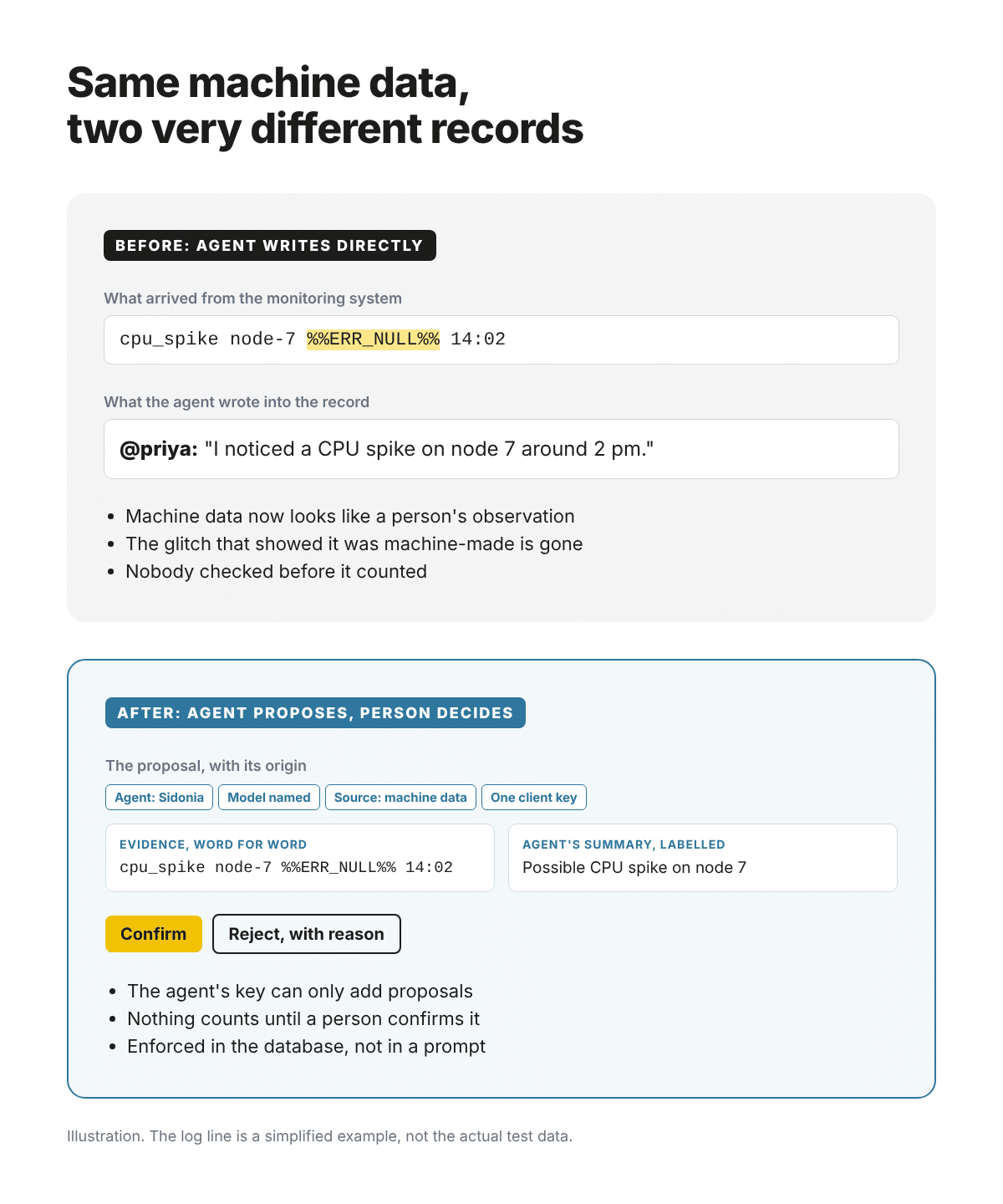
AI agents can now work inside AINODIS without ever writing into the record on their own. Every proposal waits for a person to confirm it.
Background
AINODIS helps organisations answer one question about every AI system they use: what is it allowed to decide on its own, and who answers for it?
An AI agent is software that doesn’t just answer questions. It does things: it reads records, writes notes, sends emails. That makes agents useful, and it also makes them a governance question. When an agent does something, someone has to be able to say whether it was allowed to.
In October 2026 I asked myself a simple question: to what extent could AINODIS use AI agents itself? A lot of the work in governance is legwork, like collecting evidence, chasing people for answers and reading through systems. Agents are good at legwork.
So I built some. By November 2026 AINODIS had several agents of its own:
- Sidonia takes my field notes from a chat app and brings them into AINODIS.
- The Chaser emails a person a link to review and accept the rules for an AI system they own, and reminds them if they don’t answer.
- The Code Scout reads code repositories and points out where AI is being used.
- The Jira Scout reads Jira and Confluence and points out which AI agents changed which tickets.
- The RCA agent drafts a “5 Whys” analysis after an incident and cites a record for every answer.
Plus two internal agents, the Assessor and the Designer, which draft assessments and designs inside AINODIS.
That raised the obvious next question, the one every buyer eventually asks a governance company: why should anyone trust your agents? The only honest answer was to govern them with AINODIS, by the same rules I ask clients to follow.
Benefits
The same rules, applied to myself. Every agent I built sits in the register with an owner and a level, and its work is checked the way a client’s would be. When a buyer asks “why should we trust your agents?”, I can show them.
It found a gap in my own product. I mapped the Jira Scout’s work as a storyboard, step by step, the same way AINODIS maps a client’s process. It found one unguarded handoff, at step 4: the text of an assessment was being saved without a person approving it. That one is on me. The fix is logged: a person approves the text before it’s saved.
It caught a mistake about AI ownership. The Code Scout scanned my six code repositories and proposed 9 AI systems and agents, each linked to the exact file and line. For one repository it suggested “Claude” as the owner, because an AI coding assistant had made most of the commits. I changed the rule: AI assistants and bots are never suggested as owners. An AI can’t answer for an AI.
Every finding was checked. In this test, every finding from every agent went through a person before it counted.
The work got lighter, not heavier. Instead of typing records into forms, I confirm or reject proposals. The legwork is the agents’; the decisions stay mine.
What’s next
Two agents still sit at “Decide” with no gate: the Assessor and the Designer. I’ve chosen to leave them there for now, because adding a confirmation step would slow down the work at this stage. That choice is on record in the register, where anyone can see it. The next step is to move both to propose-and-confirm, like the others.
After that, the plan is to let the register show each agent’s record over time: how often its proposals are confirmed, and how often they’re rejected and why. That’s the evidence for giving an agent more autonomy, or less.
“The point of knowing exactly what your AI may do is being able to let it do more.”
– Sébastien Fabre, founder, AINODIS
Digital
problem
solver…
Let’s get together and talk about your unique challenges – I’m friendly, approachable and love to work with other people to quickly solve digital problems using innovative technology.