Problem, solved.
The agent asked. The rules said no.
The Background
Most AI governance happens after the fact. Someone writes down what an AI system may do, and later someone checks. With agents that act in seconds, finding out weeks later is too late.
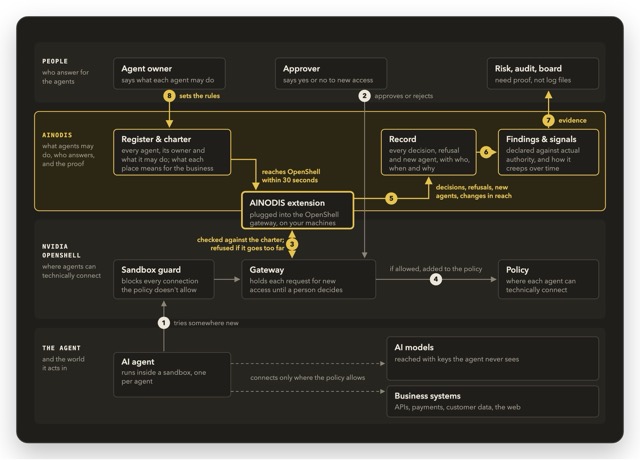
In October 2026 I tested whether Ainodis could close that gap with NVIDIA OpenShell. OpenShell is free, open-source software that runs each AI agent in its own sealed box, called a sandbox. The agent can’t reach a website or open a file unless a rule allows it. When it needs something new, OpenShell stops and asks a person.
That controls access. It doesn’t know what the access means for the business, how much freedom the agent was given, or who answers for it. That’s what Ainodis records.
I ran the test in Docker containers on my own computer, with a sample agent from OpenShell’s tutorial. No client systems or data were involved. Ainodis is a member of the NVIDIA Inception program for startups. OpenShell is NVIDIA’s project. The integration is my own work, and NVIDIA hasn’t reviewed or endorsed it.
The Benefits
Governance happens at the moment of decision, not in a report weeks later. The owner decides in AINODIS what an agent may do, and OpenShell enforces it.
Every refusal names a reason and an owner, and tells the person what to do next. Authority creep becomes visible from evidence, not opinion. A decision made under a shared certificate is labelled as weaker evidence. People keep working in OpenShell, so there’s no new screen to check.
What’s not covered yet
Rule changes made directly in OpenShell aren’t checked. If the extension is down, approvals go through unchecked. A real person only shows up as the approver once OpenShell has personal sign-in. Next, I’ll package the extension for any team running OpenShell and share these findings with the OpenShell team.
What’s different here
I’m not the only one connecting governance to OpenShell. NVIDIA, SAP, ModelOp and others are working on it too, which says the gap is real. Most of that work pushes central policy into the sandbox or routes blocked actions to a reviewer. This test did something narrower: it gave each agent a level of autonomy, gave each address a business meaning, and checked a person’s approval against both at the moment it was made. OpenShell’s own check asks whether a request is risky. This one asks whether it was agreed.
“Ainodis decides what an agent may do. OpenShell enforces it.”
– Ainodis design principle
Digital
problem
solver…
Let’s get together and talk about your unique challenges – I’m friendly, approachable and love to work with other people to quickly solve digital problems using innovative technology.