Find out more
Problem, solved.
Showing which AI agent acted, who owns it, and whether a person stepped in. A field test on Jira and Confluence.
The Background
Ainodis is my AI governance practice. Its core idea is simple: governance works when it’s designed into the way people already work, not written into a policy nobody reads.
To test that idea on real tools, I connected Ainodis to a Jira and Confluence site through Atlassian’s MCP server. Small programs I call scouts read tickets and pages and send what they find to Ainodis, where a person confirms it. Confluence holds the requirements, and Ainodis treats them as the policy to check against.
I ran this on my own trial site, with sample data, not client data. Then I added AI agents and watched what the records showed.
The Problem
AI agents often act under the identity of the person who started them. That’s true across platforms, not only in Atlassian.
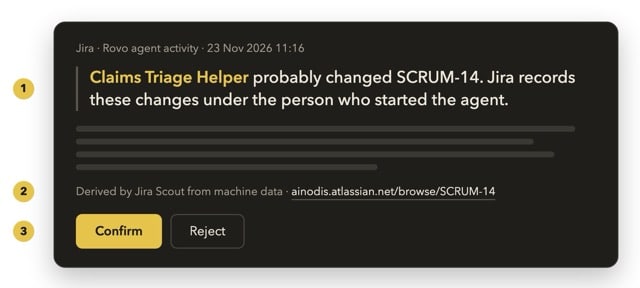
So when an agent updates a ticket, the history shows a person. The person may not have read the change. A reviewer can’t tell agent work from human work. An auditor can’t answer the basic questions. Who did this? Was it a person or an agent acting for them? Did anyone check it before it went out?
It hides the corrections too. When a person undoes an agent’s work, the record shows a person changing their mind. The correction disappears.
There was a second gap. I had no way to ask the platform which agents exist on a site. Without that list, nobody can say who owns each agent or what it’s allowed to do.
These aren’t edge cases. As teams give agents more work, the records drift further from what really happened. Human oversight only means something if you can see where it took place.
The Solution
Atlassian’s platform already holds most of the evidence. The MCP server, the audit log and the page analytics gave me the records I needed.
Ainodis joins three of them. The audit log shows that an agent ran. The Jira history shows what changed on which ticket. Page analytics show what was read. Fixed rules link the three. Ainodis then proposes “probably this agent”, and a person confirms. People stay in charge of the conclusion.
Every finding is computed from those records, not generated by a model. A person can send any finding’s fix to Jira as a ticket, with an owner and a link back. When the Jira ticket is done, Ainodis reads it back as evidence, and the next assessment shows whether the gap has closed.
Then I undid an agent’s change twelve minutes later. Jira recorded it as me changing my mind. Ainodis records it as what it was: a person correcting an agent. That number tells you whether an agent deserves more autonomy or less. Without attribution, it is always zero.
The Benefits
The trial showed what attribution makes possible. A team can see which work agents did and where a person stepped in. Each agent can have an owner who is accountable for it. An auditor gets evidence they can check, not a summary they have to trust.
The work also produced product feedback. A stable identity for each agent, and an API to list the agents on a site, would make agent work traceable by default. That would let customers give Rovo more autonomy with confidence.
“Computed, not generated.”
– Ainodis design principle
Digital
problem
solver…
Let’s get together and talk about your unique challenges – I’m friendly, approachable and love to work with other people to quickly solve digital problems using innovative technology.
Contact me
Oops! We could not locate your form.