Problem, solved.
Every rule passed. The agent still got through.
The Background
In October I connected Ainodis to NVIDIA OpenShell, free software that runs each AI agent in its own sealed box, called a sandbox. OpenShell decides where an agent can connect. Ainodis records what each connection means for the business, and how far each agent is allowed to go: only suggest, filter, decide, or act on its own.
The result was a check that works while things happen. When someone approves a request that goes beyond what an agent is allowed to do, the approval is refused, with the reason and the name of the agent’s owner. I wrote about that test in “The agent asked. The rules said no.”
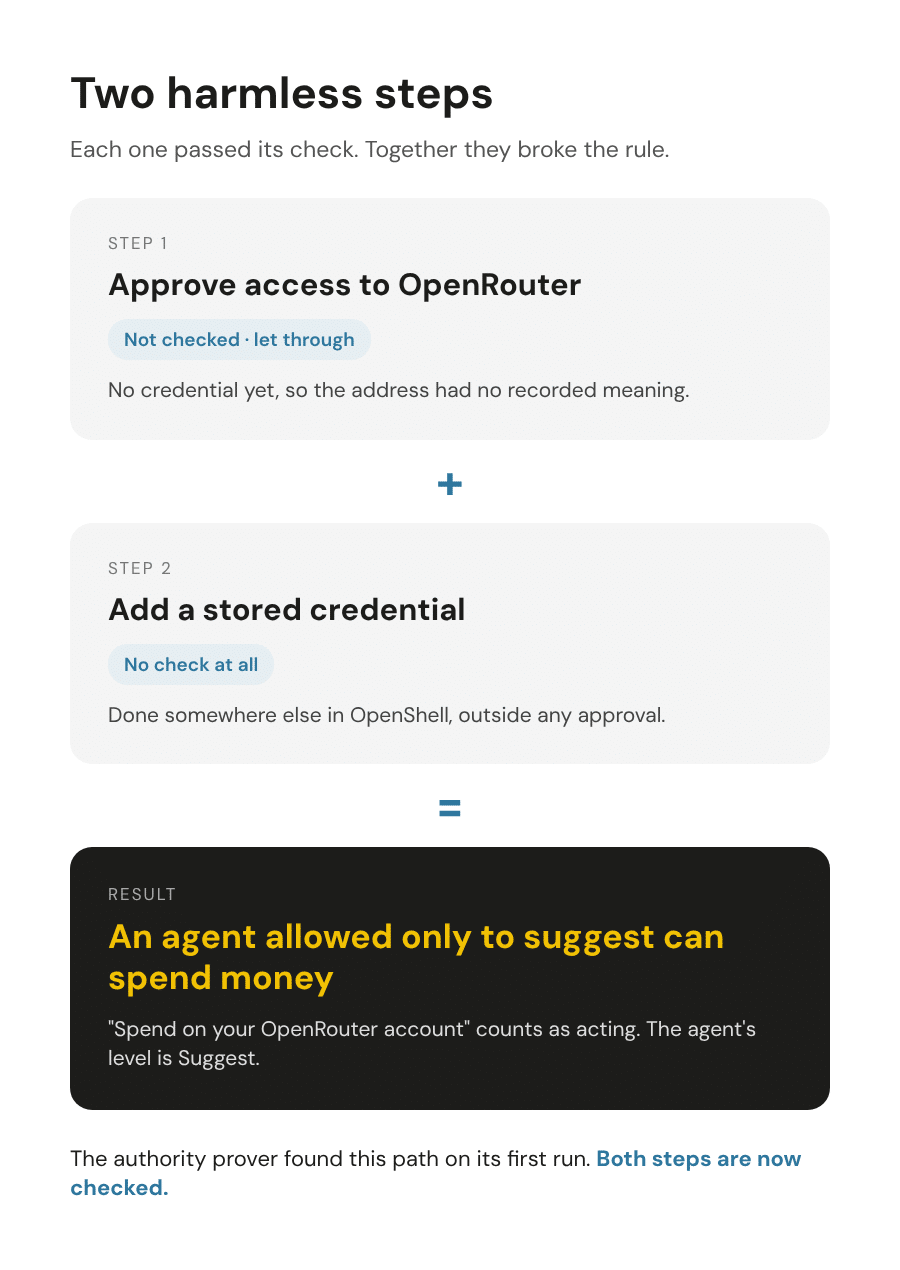
But a check like that looks at one request at a time. Agents don’t gain power in one request. They gain it in small steps, each of which looks harmless. So the next question was: if every step passes its check, can the steps still add up to something nobody agreed to?
I ran this test in a lab on my own computer, from 26 to 28 November 2026, with the same sample agent as before: a free coding assistant from OpenShell’s tutorial. It is allowed only to suggest. No client systems or client data were involved.
OpenShell is NVIDIA’s project. Ainodis is a member of the NVIDIA Inception program. The integration is my own work, and NVIDIA hasn’t reviewed or endorsed it.
The Benefits
It found a real flaw, in my own product. The prover found a way past the check I had built and written about, on its first run. The fix took a day. Without the prover, I wouldn’t have known to look.
It looks at combinations, not just single requests. The question “can this agent, by any path, do more than we agreed?” now gets an answer from a proof, not from someone reading logs afterwards.
It’s fast enough to prevent, not just report. The proof runs while the change is being made, in tens of milliseconds, well inside the half-second window.
It’s honest about what it doesn’t know. An address with no recorded meaning is reported as “not settled”, never assumed safe. Every proof states the assumptions it rests on.
Once the model included every way a rule can change, the prover also found both known gaps as one-step paths, without being pointed at them.
Some things aren’t covered yet. Direct rule changes in OpenShell still aren’t checked, and the prover finds that path every time. If the extension is down, changes go through unchecked. When a credential is refused, OpenShell’s command line only shows “permission denied”. The full reason, naming the owner, is in the log and in Ainodis. And with only one system in the model, a simpler search would have found these paths too.
That’s why the next step is a second system. An agent in Jira acts with the permissions of the person who started it. Combine that with what its sandbox allows, and the paths get hard to see by hand. That’s where proving them matters most, and where the solver earns its place. I also want a university partner, to check the model and the claims independently.
Most tools for OpenShell check each request against rules. This test asked a different question: whether any series of allowed steps can lead somewhere the rules forbid. It answered in time to prevent the step, and it started by finding a hole in my own work.
“A check that looks at one request can’t see where the steps lead.”
– Ainodis design principle
Digital
problem
solver…
Let’s get together and talk about your unique challenges – I’m friendly, approachable and love to work with other people to quickly solve digital problems using innovative technology.