Problem, solved.
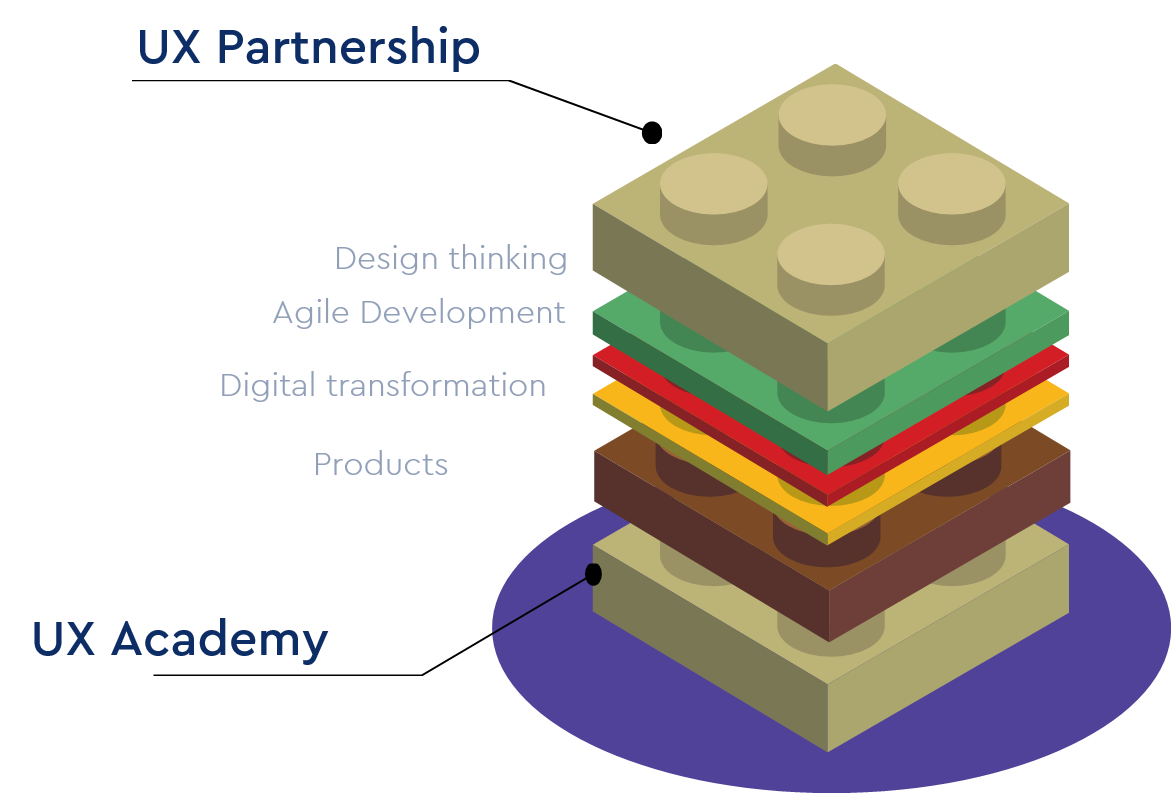
Created the first of its kind UX Academy to raise UX awareness, leading to a Gartner article and a UX Guild.
Background
I aimed to improve the user experience across all LEGO employee facing applications but struggled to scale my limited UX design resources. I built an enterprise UX mindset across the product organization by providing product teams and leadership with the knowledge and resources to incorporate UX needs into ongoing delivery that support product objectives.
The Solution
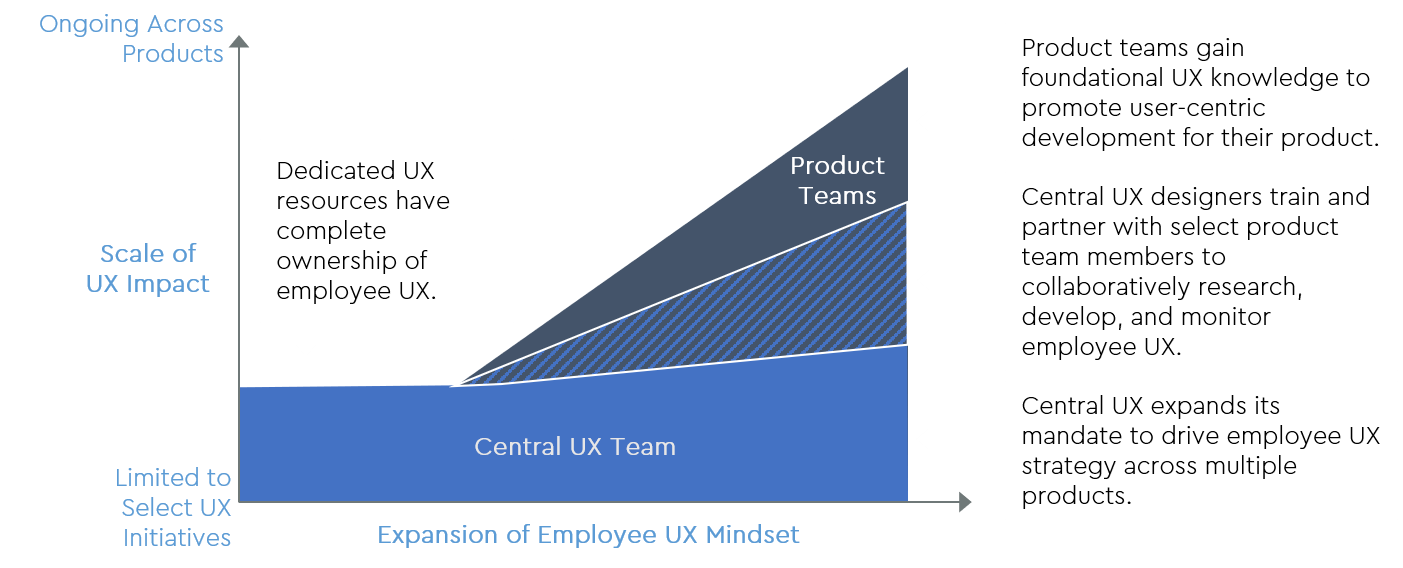
To scale the impact of employee UX expertise across products, and to foster self-sufficient product teams, I realized that UX knowledge and skills could no longer be restricted to my central UX team, and that foundational UX knowledge should be nurtured across the product organization (see Figure 1).
I achieved this by having UX designers train and partner with select product team members to collaboratively research, develop and monitor employee UX. This equiped product teams with the foundational UX knowledge necessary to promote user-centric development for their product, and enabled my central UX team to expand its mandate to drive employee UX strategy across all products.
The Benefits
- Experiential UX learning and mentoring extend employee UX knowledge to product teams: Central UX designers teach foundational employee UX techniques to select product team members through an experiential “UX academy” and partner with them after graduation to promote user-centric development for their products.
- Defined metrics are employed to collaboratively monitor and improve product UX: Product teams partner with central UX designers to monitor a set of standardized and product-specific employee UX metrics to inform decisions regarding each product’s UX needs and opportunities.
- Democratized UX insights are used to support continuous delivery: UX designers and UX academy graduates on product teams work together to capture and document discrete user research insights on an ongoing basis. This allows product teams to incorporate them into continuous delivery.
“With UX academy, development conversations by product teams are now rooted in how users actually use our products in their daily work. Now, continuous interaction with end users is at the center of our work. It’s enabled smaller but more valuable increments as products are developed and deployed.”
– Morten Lundsgaard Degn, the LEGO Group’s Vice President for Manufacturing and Supply Chain Technology
Digital
problem
solver…
Let’s get together and talk about your unique challenges – I’m friendly, approachable and love to work with other people to quickly solve digital problems using innovative technology.